
In PE and strength training, we’re always asking students to reflect on their performance. Too often, that ends up being a vague question and a half-hearted response.
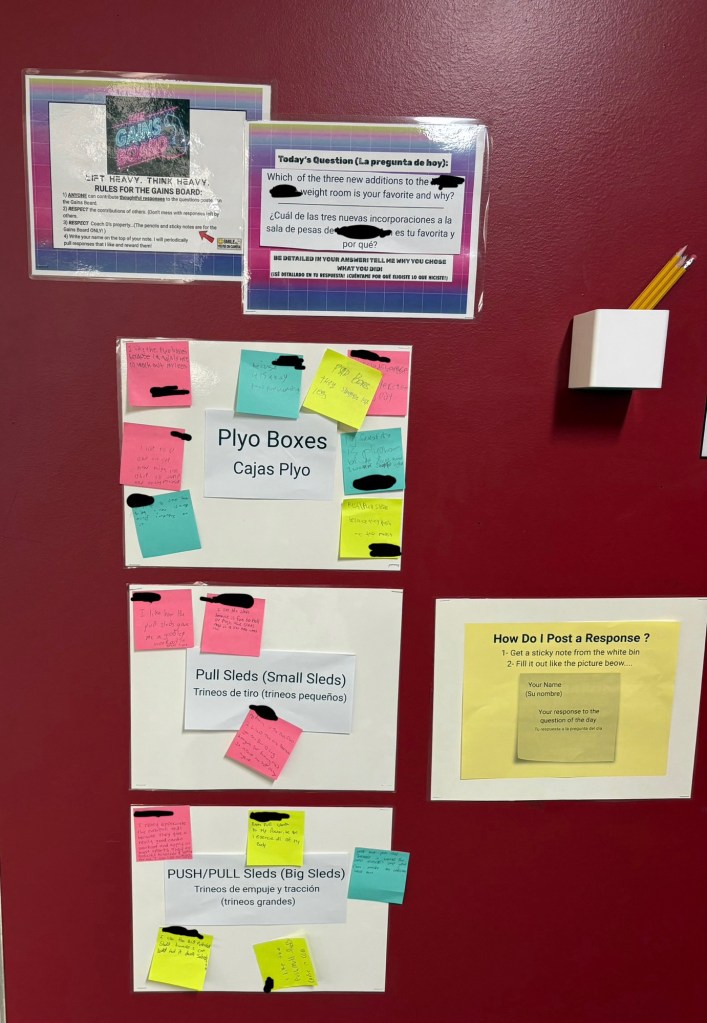
The Film Room—and its weight room counterpart, the Gains Board—change that. They give students a central space to pause, think, and respond to more meaningful prompts. The best part? It sneaks literacy into the flow of class without stealing time away from movement.

A Small Story, A Big Takeaway
One of my students this year comes from a multilingual background. Her language skills are stronger than many of her dual-language peers, but like a lot of students learning in more than one language, vocabulary can be a real challenge—especially in strength and conditioning, where language plays a major role in how we describe movement, effort, and form.
When teaching strength training, vocabulary isn’t just “extra”—it’s essential. It’s how students process what a lift should feel like or where they should be generating effort. So, when she was asked to respond to a Gains Board prompt about which part of the bench press she struggled with most, her response stood out:
“It’s hard for me because I don’t have too much force.”

The prompt had asked her to identify a part of the lift—she chose “bar path.” But her explanation revealed something deeper. In follow-up conversations, we unpacked that what she really meant was that her lack of strength made it difficult for her to maintain a straight bar path both lowering and pressing the bar.
Her choice of the word force wasn’t technically wrong—it was actually pretty insightful. It showed that she understood, in her own words, the relationship between strength, control, and physics in the movement. And it reminded me how critical vocabulary is in PE: not just the teacher’s vocabulary, but the student’s.
That single response gave me a clearer picture of what she was experiencing and helped me coach her better. It also reinforced how literacy tools like the Gains Board can help students—especially multilingual learners—express understanding and connect language to performance.
How to Build It Into Your Routine
Post your board somewhere visible—by the whiteboard, near the entrance, or wherever students naturally pass. Ask them to add their responses before class, after class, or during quick breaks. Once the habit sets in, it becomes part of the rhythm and culture of your classroom.
The prompts don’t need to be too complicated. Examples:
“Which part of the squat do you find the most challenging—depth, foot placement, or core stability? Why?”
“When training endurance, which factor challenges you most—pace, consistency, or recovery?”
“In soccer, which skill feels toughest right now—passing accuracy, trapping, or spacing?”
“During gameplay, which area is hardest to balance—team communication, positioning, or decision-making?”
You’ll be amazed at how much students reveal—both about their performance and about their understanding of key vocabulary.
One Fun Note
This past week, the wall where my Gains Board typically hangs was being repainted, so I had to take it down. By the second day, students started asking where it went. A few called me out for not updating the weekly question, and one even asked—dare I say it—with the kind of disappointed tone that only comes when a routine has become something students actually look forward to.
For a tool that many PE teachers assume students would resist—because “they don’t like to write in PE”—it’s become a genuine part of our class culture. The truth is, when literacy feels relevant, students don’t fight it. They expect it. And when it’s gone, they miss it.
Honestly, that might be the biggest gain of all.



Leave a Reply